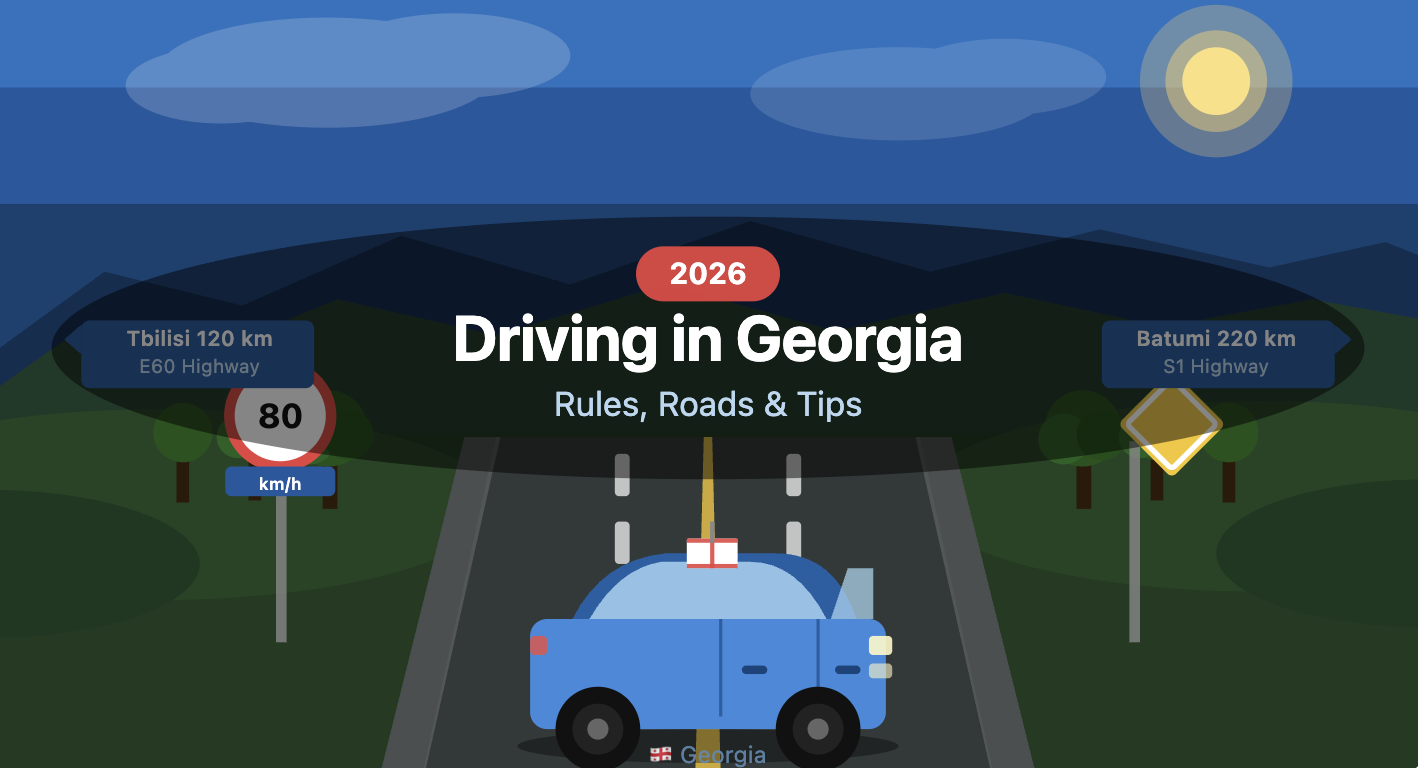
Georgia surprises most first-time visitors behind the wheel. The roads are better than expected on main routes, the scenery is extraordinary, and outside Tbilisi traffic is light. The driving culture takes some adjustment — but nothing that an experienced driver cannot read within the first hour.
This guide covers everything a foreign driver needs to know before getting behind the wheel in Georgia: rules, road conditions, licence requirements, fuel, and the practical details that most guides skip.
For the main routes — Tbilisi to Batumi, Tbilisi to Kazbegi, Tbilisi to Kakheti — no. These are well-maintained highways and regional roads that any competent driver handles without difficulty. The challenge in Georgia is specific: Tbilisi city traffic is aggressive and fast-moving, mountain roads require patience and appropriate vehicles, and some secondary roads in rural areas are in poor condition.
The honest assessment is that Georgia rewards drivers who read conditions carefully and penalises those who do not. That is true of most countries with varied terrain.
Foreign driving licences are valid in Georgia provided the licence includes an English-language section. This covers the majority of EU, UK, US, Canadian, Australian, and most other international licences.
If your licence is issued only in a non-Latin script — Arabic, Chinese, Georgian script for some older CIS licences — you need one of the following before driving in Georgia:
An IDP on its own is not valid without the accompanying national licence.
If you are unsure whether your licence qualifies, send a photo to the operator via WhatsApp before booking — it takes two minutes to confirm.
Speed cameras operate on most major routes including the E60 and the Georgian Military Highway. Fines are issued automatically and are not trivial. Drive to the posted limit.
The legal blood alcohol limit in Georgia is 0.0% for drivers. Zero tolerance. This is not a technicality — it is enforced, and the penalties are serious. Do not drink and drive in Georgia under any interpretation of the rule.
Seatbelts are mandatory for all occupants in all seats. Georgian law requires appropriate child restraints for passengers below a certain age and size — if you are travelling with children, confirm child seat availability when booking.
Using a handheld mobile phone while driving is prohibited. Hands-free is permitted.
Headlights must be on at all times when driving outside built-up areas, regardless of time of day or weather conditions. This is a legal requirement and is enforced.
In Georgia, vehicles on the right have priority at unmarked intersections. In practice, Tbilisi's busier junctions are controlled by traffic lights or police. On smaller roads and in rural areas, the right-of-way rule applies.
Roundabouts: vehicles already on the roundabout have priority unless signed otherwise.
Georgians use the horn frequently and without the social weight it carries in northern Europe. A horn here is often informational rather than aggressive — alerting a pedestrian, signalling a pass on a mountain road. Do not read horn use as hostility.
Tbilisi traffic is dense, fast-moving, and unpredictable. Lane discipline is loose. Merging is assertive. Pedestrians cross without warning. The old town's cobblestone streets are narrow and were not designed for cars.
For the first day in the country, consider parking on the edge of the old town and walking. Tbilisi is compact enough to cover on foot, and avoiding city driving on day one lets you adjust to Georgian road culture before you need to read it at speed.
The E60 between Tbilisi, Kutaisi, and Batumi is a well-maintained dual carriageway for most of its length. Overtaking is common and sometimes ambitious. Keep right except when overtaking.
The Georgian Military Highway (S3) to Kazbegi is a single carriageway road that climbs to 2,379 metres at the Jvari Pass. The road is paved throughout and well-maintained, but the gradient and width demand attention. Trucks and marshrutkas use this road — be patient when overtaking on the descent.
Mountain roads in Georgia vary enormously. The approach to Mestia in Svaneti is paved but demanding — narrow, steep, and long. Side roads to villages and smaller monasteries are frequently unpaved and require a crossover or SUV.
The rule in Georgia is: if the road leaves the main network and you are not sure what is ahead, check with the operator before you drive it. This takes two minutes via WhatsApp and saves significant difficulty.
Away from the main routes, road quality drops sharply. Potholes, missing road markings, and unpaved sections are common on secondary roads in rural areas. Reduce speed and increase following distance. Livestock on the road is a genuine hazard in some regions — particularly in Kakheti and Racha.
Georgia has two main fuel types in widespread use: regular petrol (93 and 95 octane) and diesel. LPG is available at some stations. Electric charging infrastructure is limited outside Tbilisi.
Fuel prices in Georgia are generally lower than Western Europe. Payment is usually at the pump or inside the station — most accept card, some rural stations prefer cash. Fill up in major towns before heading into mountain areas. The assumption that there will be a petrol station when you need one does not hold in remote regions.
In Tbilisi, paid parking zones operate in the city centre. The Tbilisi Parking app handles payment and is the most reliable method. Street parking outside the central zone is generally free.
Outside Tbilisi, parking is informal. At monasteries, fortresses, and natural attractions, roadside parking is standard and free. At busy tourist sites in summer, arrive early — Kazbegi town fills up by midday in peak season.
Georgia has no toll roads on any of the main tourist routes. There are no vignettes or road taxes for foreign-registered vehicles. Driving from Tbilisi to Batumi or Kutaisi to Mestia costs nothing in road fees beyond fuel.
Georgian driving culture has a reputation. It is not undeserved, but it is also not as alarming as some accounts suggest. A few things to understand:
Overtaking happens frequently and on roads where a northern European driver would not attempt it. This is normal here. Stay to the right, signal clearly, and do not be surprised when vehicles pass on a straight mountain road.
Pedestrians do not reliably wait for a green light. In Tbilisi and smaller towns, pedestrians cross wherever and whenever. Scan intersections carefully, even on green.
Marshrutkas and minibuses stop without warning to pick up and drop off passengers. Leave extra space behind them.
Animals on the road are a real hazard in rural areas — cows, sheep, and dogs move across roads without warning. In Kakheti and western Georgia particularly, reduce speed in areas where livestock is visible near the road.
Night driving on mountain roads is best avoided if you are unfamiliar with the route. The roads are not lit and the drops are significant.
If you are involved in an accident, call 112 and contact the StarCar operator via WhatsApp immediately. Do not move the vehicle until police have documented the scene if another party is involved.
Can I use my foreign driving licence in Georgia?
Yes, if your licence includes an English-language section. If not, you need a certified English translation or an International Driving Permit carried alongside your national licence.
What is the speed limit in Georgia?
60 km/h in towns, 80 km/h on open roads, 100 km/h on highways. Speed cameras operate on major routes. Fines are automatic.
Is driving in Georgia safe?
On main routes, yes — road quality is good and distances are manageable. The risks are specific: Tbilisi traffic requires attention, mountain roads require appropriate vehicles and driving experience, and some secondary roads are in poor condition. Driving within your abilities and consulting the operator on route conditions before mountain drives mitigates the main risks.
What side of the road do Georgians drive on?
The right side, as in most of continental Europe and the US.
Do I need an International Driving Permit for Georgia?
Only if your licence does not include an English section. Most EU, UK, US, and Australian licences are valid as-is.
A rental car is the only way to see Georgia properly — public transport between regions is slow, infrequent, and inflexible. With a car, the full country opens up.
Book direct at starcar.ge — no deposit, unlimited mileage, age 20 and over accepted. Full fleet at starcar.ge/cars. Pickup at Tbilisi airport, Kutaisi airport, and Batumi.
Free cancellation · 24/7 support · Unlimited mileage
Book your rental car today.
Free cancellation available